Please keep in mind that when an ACL injury occurs it is likely that other structures of the
knee may have also being injured.
An ACL tear can occur in one or combination of the following ways:
Changing direction rapidly, Stopping suddenly, Slowing down while running, Landing from a jump incorrectly, Direct
contact or collision, such as a football tackle.
It's is very common in sports such as rugby, football and basketball. Women are 2.4-9.7 times more likely to sustain an ACL injury in comparison to
males.
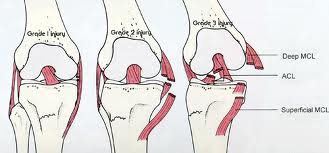
Because ligament injuries are referred to as sprains, they are given grades from I-III, with
grade I being the least severe and III the most severe. The grades and
their classification are listed below. (Brukner and Khan, 2009)
Ligament injuries are referred to as sprains and are given grades from I-III according to the
level of severity. The list below shows the grades and classifications.
Grade I.
The ligament is mildly damage. It has been slightly stretched, but is still able to help keep the knee joint stable
and you may not notice an immediate drop in sports performance.
Grade II.
The ligament is stretched until it becomes loose. This is often referred to as a partial tear of the
ligament.
Grade III.
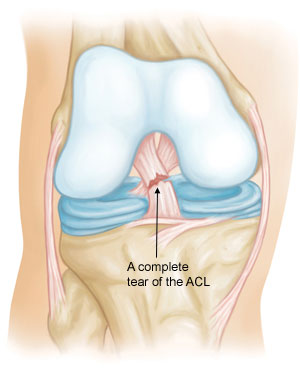
This is a complete tear of the ligament. The ligament has been split into two pieces, and the knee joint is
unstable.
Signs and symptoms
Some ACL injuries are associated with a loud "pop" sound. There is usually severe pain and inability to
continue the activity. There is also swelling at the knee that tends to get worse for up 4
hours after the injury occurred. In addition, there is the feeling of instability or the joint
"giving way" on weight bearing.
Image source
ACL damage normally tends to be complete tear or near to the point of complete tear. Partial tear is not very
common.