
|
|
Intermediate rehabilitation exercise for ACL injuries to help regain proprioception Where possible all exercise should be carried out with an assistance on hand to offer aid should the need arise. Time frame is 3-5 weeks but each athlete's rate of recovery may differ and should be taken into consideration. Injured athletes should progress through each activity at their own pace and move on when they can carry out each task accurately and comfortably.
Exercise in the intermediate rehabilitation program should start from where the early rehabilitation program ended. Exercise 1-6 should span week 1 and the middle of week 2. During week 2 the other exercises should be added according to the progress the athlete is making. If an exercise is too difficult, a previous exercise can be used and modified to add more difficulty, then go from there.
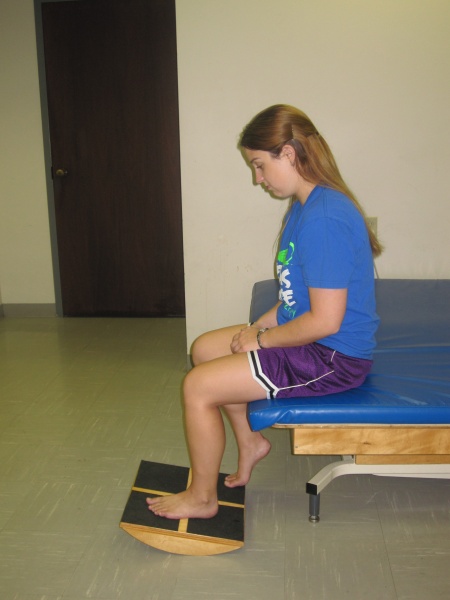
Exercise 1 Sit with both legs on the rocker board. Tilt board forward and backward, then do the same exercise with just the injured leg. This will get the athlete accustom to the movement of the board and start the process of activating the sensory receptors in the leg in preparation for the next exercise. This can be done for 3-5 minutes (m), 3 times per week.
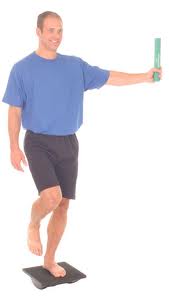
Exercise 2 Unilateral stand on Rocker Board This is first done standing with the uninjured leg on the rocker board with foam underneath it for some stability. When confident and comfortable, progress to the injured leg. This exercise should be done holding on to someone or a wall for support until enough progress have been made to do it without. This should be for 3 x 30 seconds (s), up to 3 times per week. To increase difficulty close eyes. Progress to standing on rocker board without foam underneath it with both uninjured and injured leg for 3 x 30s each, and again increase difficulty by closing eyes.
Exercise 3 Unilateral stand on the Bosu Balance Trainer This is first done standing with the uninjured leg on the flat side of Bosu Balance Trainer while balancing against a therapist or wall for 3 x 30s. When comfortable progress to the injured leg and again do 3 x 30s. To increase difficulty close eyes. Progress to standing on the bubble side, uninjured then injured leg for 3 x 30s each and again increase difficulty by closing eyes. This can be done up to 3 times per week. See video for demonstration.
Exercise 4
Unstable surface with perturbation
First the athlete stands on a cushion, while the therapist cause perturbation by shoulder
taps. This should be done for 2 x 30s. For progression when athlete is confident and comfortable, a wobble disc
should be used and then a Bosu Balance Trainer with assistance on hand or using the wall for
balance. At this stage sets should be increased to 3 x 30s and should be done 3 times per
week.
Exercise 5
Partial Squats
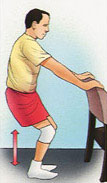
To do this exercise the athlete should hold on to the back of a chair, squat to 110 degrees and
hold for 3-5 seconds then repeat. Do 3 sets of 10, 3 times per weak. This exercise is good for
mechanically loading the muscles and structures around the knee, resulting in physiological
adaptation by changing the structure of the collagen fibres.
Exercise 6
Mini Squats
The mini squats produce similar effect to the partial squats but it also puts more load through the
incorporated graft, making it more ligament like, by increasing its neuromuscular and
proprioceptive capabilities. This time the exercise is done without support and by squatting to
120 degrees for 8-12 repetitions. It should be done 3 times per weak. See video.
Exercise 7
Mini squats using unstable surfaces
Again this exercise is a progression from the one done before, but the use of the dyna
disc makes it more difficult to pull off and therefore develops the athlete's ability to balance
by conversely developing his neuromuscular capabilities. Duration should be for 3 x 8-12 repetitions
and should be done 3 time per week. See video.
Exercise 8
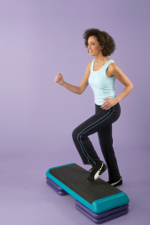
Step up step down
The athlete starts off using a platform that's not too high. Step up with the involved leg followed by the
uninvolved leg. Then step down with the involved leg fallowed by the uninvolved leg. Do this exercise for
5-10 minutes, once per day, 3 times per week. This helps to retrain gait by developing proprioception
and neuromuscular capabilities. See image.
Exercise 9
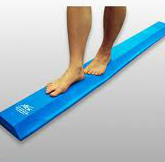
Beam Walking
The athlete walks along a narrow foam beam slowly and very deliberately. This exercise requires great
neuromuscular control, proprioception, sensory perception and balance, and thus, a good way to develop them.
The exercise is done by walking to the end of the beam unaided and back repeatedly. This should be done for
10-15 minutes, once per day, 3 times per week. See image.
Exercise 10
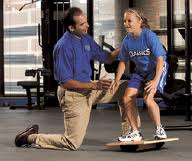
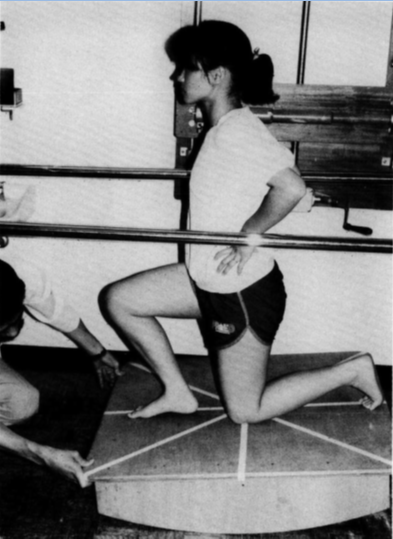
Kneeling on a Seesaw or Rocker Board Athlete kneels on a rocker board in between hand rails with uninjured leg, while the injured leg is bend to 90 degrees. The assistance rocks the board gently as the athlete tries to maintain balance. This is done for 3 x 30s, 3 times per week. The athlete should not kneel on the injured leg as it may cause pain and injury. For progression the eyes can be closed while carrying out the movement. This exercise helps to develop the athlete's sense of perception to anticipate and respond to stimuli appropriately. See image.
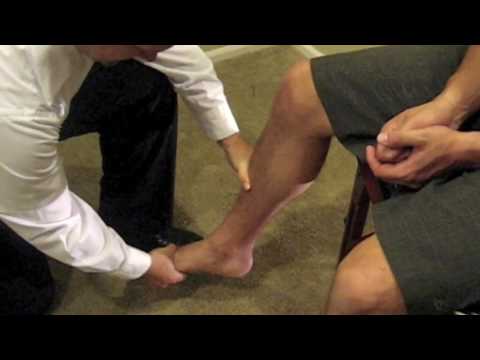
Exercise 11 Resisted thrust Athlete sits down with knees hanging over the side of a bench with eyes closed and is instructed to resist the push or pull on the lower leg of the involved side by the therapist. The therapist should aim for multi-directional movement patterns. This helps to develop the speed at which the athlete perceive and responds to stimuli, a critical component for joint protection. Do 2 x 15 reps, 3 times per week. See image. Image source
Balance reach exercises (star
exercises)
This is first done without
an unstable base. The athlete then stands on the involved leg on a cushion and use
the uninvolved leg to reach along the length of each star. This can be done twice. For progression, use
arms to reach instead of legs. If athlete is confident and comfortable, move to wobble board and carry
out the same exercises. However, this should only be done towards the end of the intermediate
rehabilitation program if the athlete made good progress. See video.
|
|
|||
